Blank Monopoly Board Printable for Custom Games
Most people have a Monopoly board tucked away in a closet. Maybe you played it during holidays, or your kids went through a phase. But the classic game has a limitation: you can only play the version someone else designed. A Printable Blank Monopoly Board Game changes that completely. It hands you the familiar structure — the square layout, the corner spaces, the property rows — and leaves everything else open. You decide what the spaces say. You decide the theme, the rules, the artwork. Whether you're building a training tool for your sales team or designing a personalized gift for a friend's 40th birthday, this blank template gives you the foundation without the constraints.
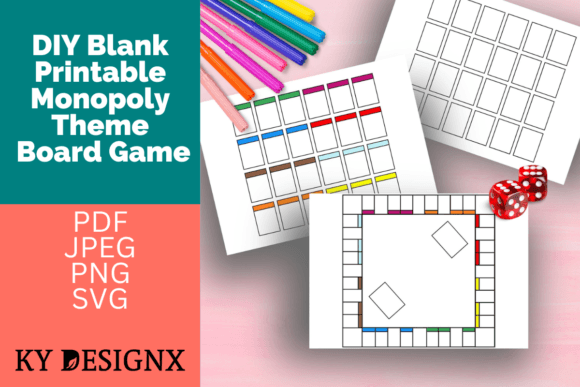
What makes these printable templates particularly useful is the format flexibility. You're not locked into one file type or one physical size. The package typically includes PDF, JPEG, PNG, and SVG versions. That matters more than most people realize until they're mid-project. A PDF works beautifully if you want to print immediately and hand-draw your content with markers. A PNG or SVG is what you need when you're pulling the board into Canva, Illustrator, or another design tool. And the size options — A4 for quick prototypes and small-group activities, plus a generous 20 by 20 inches for full-scale game night — mean you can match the output to the occasion. You're not squinting at a tiny board or wasting paper on something oversized for a classroom exercise.
Why a Blank Template Beats Starting from Scratch
If you've ever tried to design a board game layout yourself, you know the geometry gets tricky fast. Aligning 40 spaces evenly around a square, getting the corner cells proportioned correctly, leaving room for the center area — it's tedious work. A well-constructed blank template handles all that. The spaces are already measured and distributed. The classic Monopoly-inspired format is instantly recognizable, which means anyone sitting down to play already understands the basic flow: roll, move, land, act. That familiarity lowers the barrier to engagement, whether you're using the board for a corporate onboarding session or a family reunion activity.
But the real power lies in what you remove. A traditional Monopoly board comes with baked-in economic assumptions, property names tied to specific locations, and a theme that may or may not resonate with your audience. Stripping all that away lets you layer in your own context. A real estate agent might replace Atlantic Avenue with neighborhood names their clients care about. A history teacher could create a board where each property represents a different decade or event. The blank template doesn't dictate the subject — it just provides the canvas.
Digital Customization Opens New Possibilities
One of the more overlooked advantages of these printable files is how smoothly they integrate with graphic design platforms. Canva, in particular, has become the go-to for people who want professional-looking results without professional training. You upload the SVG or PNG, and suddenly you can drag and drop custom icons, adjust colors to match brand guidelines, layer in team member photos, or add subtle background textures. The template becomes a working file rather than a static printout.
This digital capability is where the line between "printable" and "design asset" blurs. For a marketing agency running an internal workshop, the board can reflect client brands and campaign milestones. For a couple planning their wedding, each property might represent a significant moment in their relationship — the first date, the proposal, the trip they took together. The customization goes deeper than just text. You can adjust typography to match a mood, incorporate illustration styles that fit a theme, and even modify the color palette of the entire board. When you start with a high-quality template, you're not learning layout fundamentals on the fly. You're making creative decisions, which is where the real satisfaction lives.
Practical Formats and How to Choose
Let's talk about the file types in practical terms. If you're running a quick activity at a conference or in a classroom, the PDF is your friend. Download, print, and you're done. The A4 size works for tabletop use, and you can print multiple copies without complexity. JPEG is similarly straightforward — it opens anywhere, prints easily, and keeps file sizes manageable.
PNG files offer transparency, which becomes useful if you're layering the board onto custom backgrounds or need to isolate the grid from its surroundings during design. And SVG is the heavyweight option for serious customization. Scalable Vector Graphics mean you can resize the board from a notecard to a billboard without losing crispness. Every line stays sharp because you're working with mathematical paths rather than pixels. If you're planning to have the board professionally printed at a shop, you'll likely want the SVG or a high-resolution PNG. The print shop will thank you, and the final product will look crisp rather than fuzzy.
Having both A4 and 20x20 inch options in the same package eliminates the headache of resizing guesswork. The smaller format is ideal for testing concepts, running prototypes, or creating portable versions. The larger format delivers the full experience — plenty of room for detailed artwork, legible text across the table, and that satisfying presence a board game should have. You can start small, iterate, and scale up when you're ready.
Who Actually Uses These Templates — and How
The audience for a Printable Blank Monopoly Board Game is broader than you might expect. Educators use them to gamify curriculum. Instead of reading a chapter on economics, students move around a board where each property represents a concept they need to explain. The chance and community chest spaces become pop quizzes or discussion prompts. Learning becomes active rather than passive, and the blank format means the teacher can tailor the content to the class level.
Corporate trainers and HR professionals have adopted these templates for onboarding. New hires land on spaces that correspond to company values, policy quizzes, or introductions to team members. It's far more memorable than a slide deck, and it encourages participation rather than passive listening. Similarly, team leads use customized boards for retrospectives or planning sessions, where each property row represents a quarter or a project phase.
On the creative side, illustrators and designers build portfolio pieces by fully theming a board. A fantasy artist might create a dungeon-crawl version with hand-drawn monsters. A food blogger could design a board where every property is a recipe or restaurant review. The blank template becomes a showcase for their visual style, and the result makes a unique content piece for social media or a website.
Families and friend groups find personal value too. One common example: a board customized with inside jokes, shared memories, and personalized "Chance" cards that reference real events. At a reunion or holiday gathering, that board becomes the center of the room. It's not just a game — it's a reflection of the group's history. The blank template makes that possible without anyone needing to draw perfectly aligned squares on poster board.
Marketing, Branding, and Customer Engagement
Small businesses and content creators are also tapping into these templates. A coffee shop might create a loyalty-program board where stamps or stickers fill the properties. A blogger could design a lead magnet — a downloadable custom board related to their niche — that captures email addresses. A nonprofit might build an awareness campaign where each space educates the player about a different aspect of their mission. Because the template is blank, the branding opportunity is complete. Logo placement, color scheme, tone of voice — all of it can align with the organization's identity.
From a brand engagement standpoint, a physical game board carries weight that a digital ad doesn't. It sits on a table. People gather around it. They handle it, read it, and talk about it. That kind of sustained attention is rare. When you can place your message inside that experience — subtly, naturally — it resonates differently than a banner or a pop-up.
Making the Most of the Creative Process
If you're new to customizing a board, start with a clear intention. Are you designing for entertainment, education, or marketing? That decision shapes everything. For entertainment, lean into visual richness and humor. For education, prioritize clarity and logical flow. For marketing, ensure brand consistency and a clear call to action somewhere in the experience — perhaps on the board itself or in accompanying cards.
Work in layers. If you're using Canva or similar software, keep text elements separate from background graphics. That way you can adjust wording without disrupting the visual design. Use the center space of the board — that large empty rectangle — wisely. It's prime real estate for a title, a logo, instructions, or an illustration that sets the tone. Don't leave it blank unless minimalism is the goal.
Test prints matter. A design that looks crisp on screen can turn muddy on paper, especially if you're using dark backgrounds or thin fonts. Print a single A4 section before committing to the full 20x20 sheet. Check contrast, readability, and how the colors reproduce on your printer. If you're sending the file to a print shop, ask them which format and color profile they prefer. Most will want CMYK for accurate printing, but RGB is standard for digital design. Confirming this upfront saves time and money.
Accessibility and Usability Considerations
When designing your board, keep players in mind. Font sizes that work on a screen may be unreadable across a table. High contrast between text and background helps everyone, but it's especially important for players with visual impairments. If you're creating a game for a diverse group, consider adding icons alongside text — visual cues transcend language barriers and reading levels.
The physical quality of your print matters too. Standard printer paper works for prototypes, but a finished board benefits from cardstock, lamination, or even mounting on foam board. If the board will be used repeatedly, protect it. A laminated surface lets players write directly on the board with dry-erase markers — useful if the game involves temporary labels or scores. Alternatively, print on heavy paper and use a clear acrylic sheet on top for durability without permanent lamination.
Stretching the Template Beyond the Board
Don't overlook the accessory elements that complete the experience. Blank property cards, customizable money, and editable chance cards all extend the personalized feel. The same design tools you use for the board can produce a cohesive set. Match the card backs to the board's color scheme. Use consistent font pairings across all components. The cohesion signals quality and care, and players notice it — even if only subconsciously.
Some users go further and design custom player tokens. Cardstock standees are the simplest route. Print characters or symbols, cut them out, and use small binder clips as bases. It's not elaborate, but it reinforces the theme. For a corporate training board, the tokens might represent different departments. For a family game, they could be caricatures of household members. These small touches elevate the experience from "printed at home" to something that feels purposeful and considered.
Digital versions of your customized board open yet another door. Screenshots or mockups of the board make excellent social media content. A "Can you guess the theme?" post with a cropped section of the board can drive engagement. Bloggers and content creators can use the board design in tutorial videos, showing the customization process step by step. The template remains the foundation, but how you extend it depends entirely on your goals.
The Printable Blank Monopoly Board Game sits at an interesting intersection of nostalgia and utility. The format is familiar enough to be approachable and blank enough to be adaptable. Whether you're printing directly onto paper and sketching with markers, or pulling vectors into sophisticated design software, the end product reflects your intent — not someone else's licensing agreement. That flexibility explains why these templates appeal to such a wide range of users, from teachers to entrepreneurs to families looking for something genuinely personal to play. The template doesn't do the creative work for you, but it removes every structural obstacle standing in your way.