The Essential Role of a Game UI Kit in Modern Game Design
In the fast-paced world of digital game development, time is the ultimate currency. Whether you're crafting a mobile app, a desktop adventure, or a browser-based puzzle game, the interface is the bridge between your creative vision and the player's experience. This is where a specialized Game UI Kit becomes not just a tool, but a strategic asset. Specifically, a Cartoon Gaming Interface kit offers a cohesive, stylized foundation that can accelerate production and elevate visual quality from the first prototype.
What Exactly is a Cartoon Gaming Interface Kit?
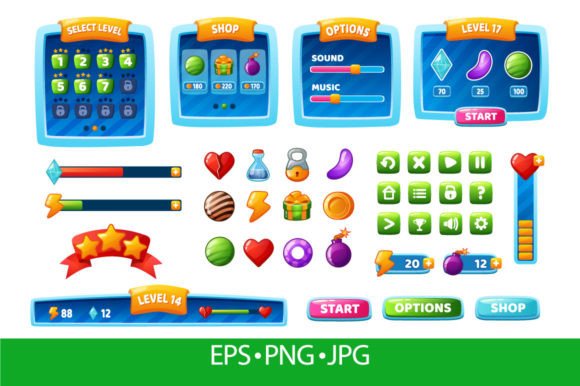
Imagine a toolbox where every component is designed to work together harmonically. A Game UI Kit focusing on a cartoon aesthetic is precisely that. It’s a comprehensive vector set of graphical elements tailored for gaming applications. This kit typically includes ready-made buttons, icons, menu panels, progress bars, and isolated indicators for scores or results. The cartoon style implies a certain visual language: bold outlines, vibrant colors, exaggerated shapes, and a sense of playful energy. This isn't about realistic textures; it’s about creating an inviting, dynamic, and often humorous visual environment that resonates with players across age groups.
The practical magic lies in the details. Each element—a "Start Game" button, a health bar panel, a gem collection icon—is crafted to fit within the same stylistic family. This consistency is crucial for professional game design. When you use a cartoon gaming interface kit, you’re not cobbling together disparate assets; you’re implementing a unified visual system.
Core Components and Their Functions
Let’s break down the key games design elements you’ll find in a typical vector set.
- Buttons & Interactive Elements: These are the touchpoints for the player. Cartoon buttons often have glossy, bubbly, or illustrated surfaces that make them look "pressable." They provide immediate visual feedback about interactive zones.
- Menu Panels & Backgrounds: The frameworks for your information. Settings menus, inventory screens, and level selection interfaces rely on these panels to organize content within the game's world without breaking the artistic flow.
- Progress Bars & Indicators: Visual feedback for progression. A cartoon-style progress bar might fill with animated sparkles or change color as it advances, turning a mundane metric into a engaging part of the experience.
- Icons & Symbolic Assets: Small, recognizable graphics for coins, power-ups, weapons, or settings. In a cartoon kit, these icons are simplified and bold for quick recognition, even on small mobile app GUI screens.
- Isolated Indicators: Elements like score counters, timer displays, or result screens ("Win!/Lose!") that need to stand out clearly. Being "isolated" means they are designed to be legible and effective on their own.
Why Integrate a Pre-Designed UI Kit Into Your Workflow?
The decision to use a pre-made Game UI Kit is often driven by practical realities. Development cycles are tight, and resources—especially for indie developers or small studios—are limited. Designing a unique, polished interface from scratch requires significant time in illustration, iteration, and asset formatting. A comprehensive cartoon gaming interface kit bypasses much of that foundational work.
You gain a production-ready starting point. Instead of staring at blank artboards, you have a library of styled components to drag, drop, customize, and arrange. This allows you to focus your energy on game mechanics, story, and level design rather than spending weeks drawing every single button variant. The kit ensures visual coherence, which is a common pitfall when assets are collected piecemeal from different sources.
Format Flexibility: EPS, PNG, and JPEG
A professional Game UI Kit provides assets in multiple formats, each serving a distinct purpose in the pipeline. The EPS (Encapsulated PostScript) vector files are the gold standard for scalability and editing. Using EPS, a designer can resize any icon or panel to any dimension without loss of quality, change colors via vector paths, or modify shapes directly in Adobe Illustrator or similar software. This is essential for tailoring the kit to your game’s specific needs.
The PNG files offer ready-to-use raster images with transparency support. They are perfect for quick implementation in game engines like Unity or Godot when you need a clean asset without immediate editing. JPEG formats might be included for broader compatibility or certain background elements, though they lack transparency. Having this multi-format set means the kit is adaptable to various stages of development—from initial mockup (using PNGs) to final, engine-integrated, scalable artwork (using EPS vectors).
Considerations for Mobile App GUI Design
The principles of a cartoon gaming interface become even more critical in the mobile space. Screen real estate is limited, and touch interactions are fundamental. The buttons must be large enough for a fingertip, visually distinct, and provide clear feedback. Cartoon-style buttons, with their bold colors and often exaggerated size, naturally meet these usability requirements.
Mobile app GUI assets from a good kit are designed with touch targets in mind. Progress bars and indicators are streamlined to convey information swiftly without cluttering the small screen. The cartoon aesthetic, being inherently attention-grabbing and joyful, can enhance the "pick-up-and-play" appeal crucial for mobile gaming success. It creates an immediate sense of fun and accessibility.
Beyond Aesthetics: The Functional Benefits
While the visual charm of a cartoon interface is obvious, the functional benefits are profound. A well-structured UI kit improves user experience by establishing predictable patterns. Players learn quickly where to tap for settings, how to read their health, and what an icon symbolizes. This reduces frustration and increases engagement. For the developer, it streamlines the iteration process. Testing different menu layouts or button placements becomes easier when the core assets are consistent and easy to manipulate.
Furthermore, using a kit can be a cost-effective strategy. Hiring a dedicated UI illustrator to create a full suite of custom cartoon elements can be expensive. A high-quality, commercially licensed Game UI Kit offers a budget-friendly alternative that still delivers a professional, cohesive look. It’s a way to achieve a high visual standard while allocating funds to other critical areas like programming or sound design.
Choosing the Right Game UI Kit for Your Project
Not all kits are created equal. Before adopting a cartoon gaming interface asset set, consider a few key factors. First, examine the scope and completeness. Does it include all the elements you foresee needing—not just generic buttons, but also specialized icons for your game’s unique mechanics? Second, assess the style consistency. Preview all components together to ensure the cartoon style is uniform across buttons, panels, and icons.
Third, verify the technical specifications. Are the vector files (EPS) properly grouped and layered for easy editing? Are the PNGs provided at high resolutions suitable for your target platforms? Finally, consider the licensing terms. Ensure the kit allows for use in commercial projects and aligns with your distribution plans. A great Game UI Kit is one that fits both your artistic vision and your practical development constraints.
In today’s game development landscape, efficiency and quality are not mutually exclusive. A thoughtfully designed Cartoon Gaming Interface kit embodies this balance. It provides the building blocks for an engaging, functional, and visually delightful player interface, freeing creators to invest their passion where it matters most: crafting the game itself. From the playful bounce of a menu button to the clear read of a victory indicator, these kits shape the moments where the player connects with your world.